Preventing Ransomware Reinfection
Cybersecurity Services by SpearTipNewsApril 27, 2026
This organization had already experienced a ransomware attack.
During a past Incident Response engagement, our Security Operations Center (SOC) maintained active monitoring of the environment to prevent reinfection. At that time, our team identified a large-scale password spraying attack targeting a publicly exposed server.
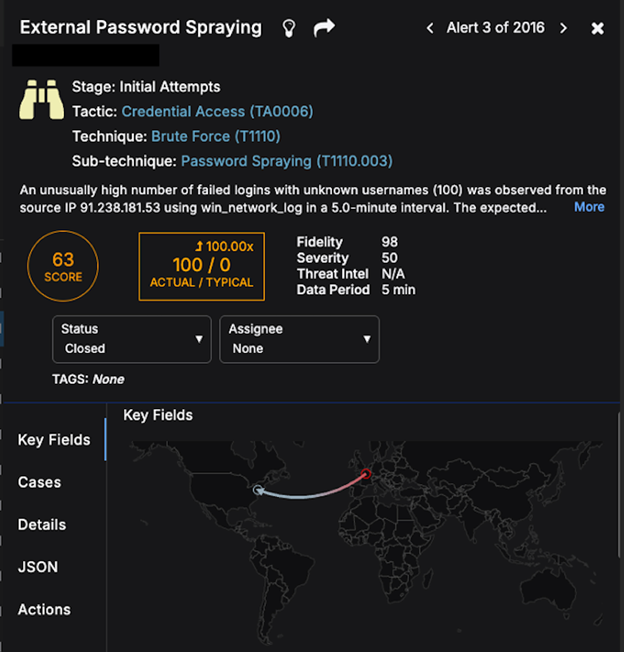
Here’s what our SOC observed:
These indicators are common in real credential-based intrusions and help show this activity was targeted and high-risk, not routine background scanning.
- 100+ usernames targeted: The attacker attempted to log in as more than 100 different users, which is a strong sign of password spraying (many accounts tested quickly to find one that works).
- Admin and Administrator accounts included: The attacker specifically tried high-privilege usernames (like Admin/Administrator) because one successful login could provide broad control and accelerate a ransomware attack.
- Traffic originating from multiple foreign countries: The login attempts came from several overseas IP addresses, which is often seen when attackers use distributed infrastructure (or compromised systems) to spread activity and avoid simple blocking.
- A publicly exposed RDP service: Remote Desktop Protocol (RDP) was reachable from the internet, creating a direct path for an attacker to attempt logins and, if successful, gain initial access.
This was not random internet ‘noise’. It was a coordinated credential-access attempt, the exact technique commonly used to gain initial access before ransomware deployment.
The progression typically looks like this:
Below is a simple, real-world view of how many ransomware attacks begin. Each step builds on the last, so stopping the chain early (especially during password spraying) can prevent account takeover, lateral movement, and ransomware deployment.
- Find an exposed system: The attacker searches the internet for a publicly accessible entry point, such as an exposed RDP server or remote access portal, that can be reached from outside the network.
- Spray credentials: The attacker runs a password spraying attack by trying a small set of common passwords across many usernames to avoid account lockouts while looking for a successful login.
- Find a weak password: One of the sprayed password guesses works, revealing a valid username and password combination (often because the password is weak, reused, or default).
- Gain access: Using the working credentials, the attacker logs in to the exposed system and establishes initial access, often with the goal of expanding control beyond that single machine.
- Move laterally: After getting in, the attacker pivots to other systems by using shared credentials, remote tools, or misconfigurations to reach file servers, domain controllers, and other high-value targets.
- Deploy payload: Once positioned across the environment, the attacker executes the final payload (often ransomware), encrypting systems and disrupting business operations to force payment or leverage extortion.
Where we stopped the attack: Step 2 (password spraying).
The attacker was still in the “trying passwords” phase and never reached a successful login. By detecting and responding during the password spraying stage, we prevented the attacker from turning repeated login attempts into initial access and stopped the usual path toward lateral movement and ransomware.
- No accounts were compromised.
- No lateral movement occurred.
- No ransomware was deployed.
That’s the difference between reacting to a breach and actively monitoring for the next one.
This is the value a SOC delivers. Learn more about how our Managed Security services can help protect your organization.